
How do you prevent cockroaches in a commercial kitchen?
The short version
You prevent cockroaches in a commercial kitchen by removing their food, water and shelter, sealing entry points, cleaning around the clock, and running a documented pest management program.
Here is the blunt truth we give every venue owner in Sydney: cockroach control is not really about spraying. It is about denying roaches a place to live. No single step carries the load. Prevention is a system, and in a busy Sydney food business that system has to hold up under a food safety audit.
Cockroaches keep venue owners awake at night, and fairly. They foul food and surfaces. They carry bacteria such as Salmonella. One sighting by a customer or an inspector can undo years of goodwill in an afternoon. This guide explains how cockroach control and compliance work together, what the law expects of a NSW food business, and how to keep your kitchen clear for good.
Why are commercial kitchens a magnet for cockroaches?
A commercial kitchen hands cockroaches everything they need to breed: warmth, moisture, food scraps and dozens of tight hiding spots. Equipment runs hot. Cleaning cycles leave residue behind. And the steady stream of deliveries carries pests in through the packaging.
The species we deal with most in Sydney kitchens is the German cockroach. It is small, it breeds fast, and it thrives in the warm gaps behind and inside equipment. A single female and her offspring can produce hundreds of cockroaches within months, which is exactly why an ignored problem runs away from you.
Common reasons kitchens attract cockroaches include:
- Heat sources such as dishwashers, ovens, fridge motors and pipework that stay warm overnight.
- Moisture from leaking taps, condensation, floor drains and wet mop areas.
- Food debris trapped under equipment, in grout lines, and inside cracks.
- Cardboard and packaging that arrives with deliveries and hides eggs.
- Clutter and dead space behind fixed equipment that never gets cleaned.
German cockroaches are nocturnal and secretive. By the time you spot them in daylight, the population is usually large and well established. That is the point where a professional treatment stops being optional.
What does the law require for pest control in NSW food businesses?
Under the Food Standards Code, every food business in NSW must take all practicable measures to prevent pests on the premises and to eradicate and prevent harbourage of pests. This is a legal obligation, not a suggestion. It sits within Standard 3.2.2 (Food Safety Practices and General Requirements) and Standard 3.2.3 (Food Premises and Equipment).
In plain terms, the Food Standards Code requires you to:
- Prevent pests entering and living on the premises.
- Eradicate and prevent the harbourage of pests on the premises.
- Keep the premises, fixtures, fittings and equipment in a clean and pest-free state.
- Ensure food is protected from contamination at all times.
The NSW Food Authority and your local council enforce these rules through inspections and the Scores on Doors program. Evidence of pests, including live cockroaches, droppings, egg cases or a smear mark, can bring penalty notices, improvement notices, prohibition orders, or in serious cases prosecution and closure. A failed inspection can also drop your public hygiene rating, and plenty of diners check that star rating before they book a table.
The Australian Standard AS 3660 series covers pest management practice more broadly, and reputable providers work to its principles. For food businesses the practical takeaway is simple. You need a documented, ongoing pest management program, not a one-off spray after a problem appears.
This article is general information only and is not a substitute for advice from the NSW Food Authority, your local council, or a licensed pest professional about your specific premises.
What do food safety auditors look for during an inspection?
Auditors look for two things: live pest activity, and proof that your kitchen is built to keep pests out. They check the physical state of the premises and they check your paperwork. Fail on either front and it counts against you.
During an inspection, expect an auditor to check:
| What they check | Where it shows up | What the auditor is looking for |
|---|---|---|
| Live activity and signs | On site | Live or dead cockroaches, droppings that look like ground pepper, shed skins, egg cases, and a musty smell in heavy infestations |
| Harbourage points | On site | Behind and under equipment, inside cracks, around motors, and in wall cavities |
| Structural gaps | On site | Damaged door seals, holes around pipework, and unsealed junctions between walls and floors |
| Cleaning standards | On site | Grease build-up, food debris in dead space, and the state of floor drains |
| Your pest management records | On file | Service reports, a site plan, treatment history and monitoring logs |
That last point catches a lot of operators out. I have watched a genuinely clean kitchen marked down simply because the owner could not produce a single service report showing a program was in place. Keeping current documentation on file is one of the easiest ways to prove compliance, and one of the most commonly forgotten.
How do you keep cockroaches out of a commercial kitchen day to day?
Daily prevention comes down to denying cockroaches food, water and shelter, and blocking the ways they get in. These habits matter more than any single treatment. They decide whether a treated kitchen stays clear or reinfests within weeks. We run through the same simple framework with every venue: starve them, dry them out, shut the doors, and screen the deliveries.
-
Remove the food source
- Clean spills immediately and wipe down surfaces at the end of every shift.
- Clear food debris from under and behind equipment, not just the visible floor.
- Store dry goods in sealed, hard containers rather than open bags or cardboard.
- Empty bins regularly and keep external bin areas clean and lidded.
- Degrease equipment, extraction filters and floor drains on a set schedule.
-
Cut off water
- Fix dripping taps, leaking pipes and condensation promptly.
- Dry down sinks, floors and prep areas overnight.
- Keep floor drains clean and flowing.
-
Close the entry points
- Fit and maintain door seals and door sweeps, especially on back doors.
- Seal gaps around pipes, cabling and wall penetrations.
- Repair cracked tiles, damaged grout and gaps at wall-to-floor junctions.
- Fit insect screens where appropriate.
-
Break down deliveries carefully
- Inspect incoming boxes for cockroaches and egg cases.
- Remove cardboard packaging quickly and avoid storing it in the kitchen.
- Rotate stock so nothing sits undisturbed long enough to harbour pests.
None of this is complicated. Consistency is the hard part. In our work with eastern suburbs cafes and takeaways, the propped-open back door during a dinner rush is the single most common way roaches walk in, and one neglected drain under the pass can undo months of careful work.
When should you call a professional pest controller?
Call a professional the moment you see any sign of cockroach activity. Better still, get ahead of it with a scheduled program before anything shows. German cockroaches breed too fast and hide too well for supermarket sprays to solve. By the time daytime sightings start, the population is already sizeable.
Book a professional inspection and treatment if:
- You have seen live cockroaches, droppings or egg cases anywhere in the kitchen.
- Staff report sightings during the day, which signals a heavy infestation.
- You are opening, fitting out or taking over a food premises.
- Your food safety audit is approaching and you want documented protection in place.
- Your current measures are not holding and pests keep returning.
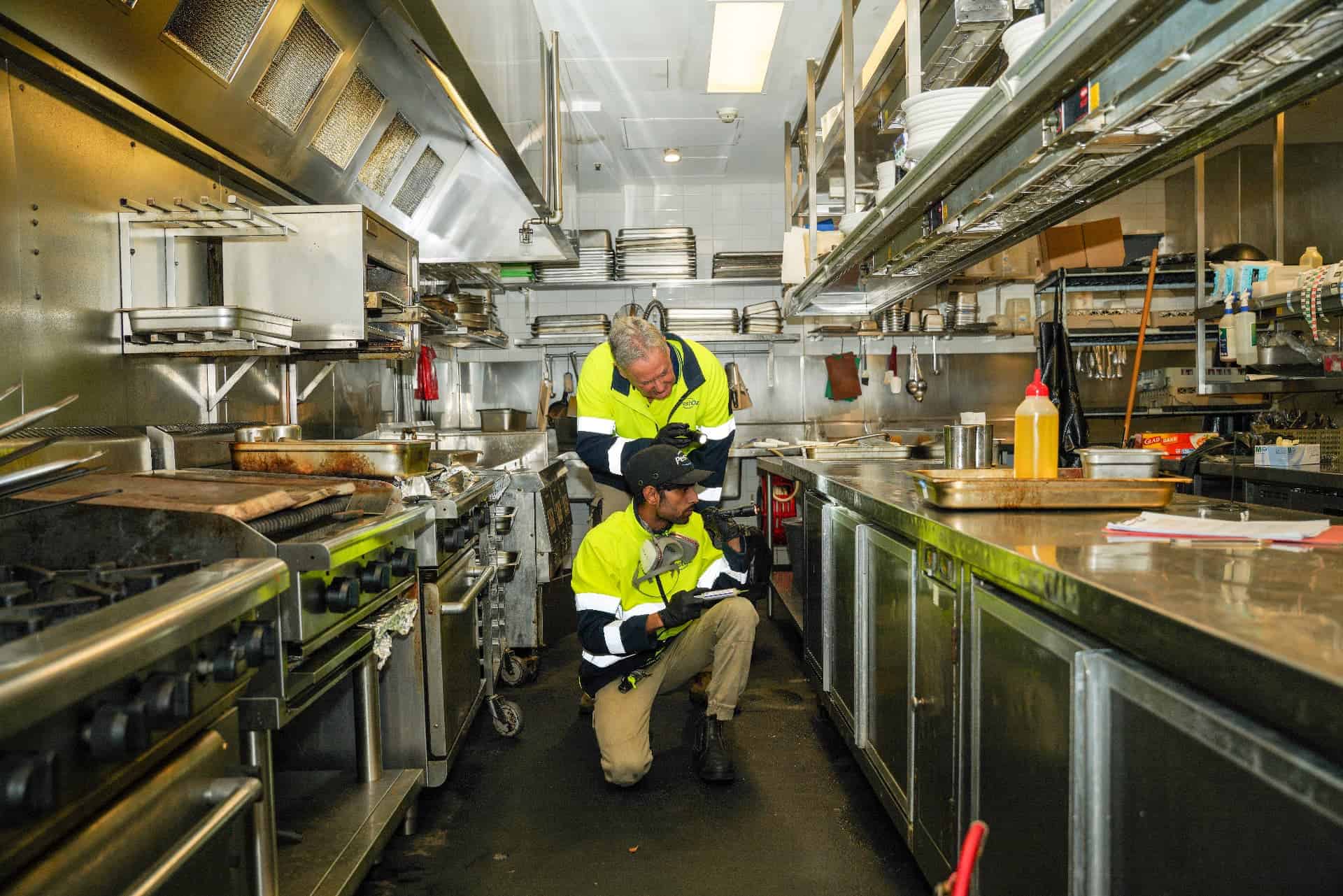
Professional treatment for a commercial kitchen usually combines targeted gel baits, crack-and-crevice work, monitoring stations and follow-up visits. The baits used against German cockroaches often contain active constituents such as indoxacarb, though a licensed technician will choose the product and method that suit your site. The aim is not just to knock down today’s population. It is to break the breeding cycle and stop reinfestation. Just as importantly, a licensed provider hands you the service documentation your auditor wants to see.
Commercial kitchen pest control
Start a Documented Pest Management Program for Your Sydney Kitchen
Tell us your venue type, your trading hours and when you were last audited. We will inspect the harbourage points, treat around service, and hand you the reports that go straight into your food safety folder. Sydney CBD, the eastern suburbs and the lower North Shore.
-
Documentation auditors accept
Service reports, site plan, treatment history and monitoring logs, kept current.
-
Built for a working kitchen
Targeted, low-disruption treatment plus ongoing monitoring and scheduled servicing.
-
Already in tier-one buildings
JLL, Knight Frank, CBRE and Solotel, plus Waratah, Net Strata and Jamesons strata.
Frequently asked questions
Cockroaches and compliance, answered
The questions Sydney venue owners and kitchen managers ask us most, answered straight, with the compliance reasoning behind each one.
Talk to a licensed technicianHow quickly can a cockroach infestation get out of control in a kitchen?
Very quickly. German cockroaches, the most common kitchen species, breed within weeks, and a small number can become hundreds in a few months. The warmth, food and moisture in a commercial kitchen speed this up, which is why early intervention matters so much.
Will one professional treatment fix the problem permanently?
Usually not on its own. A single treatment knocks down the current population, but lasting control needs follow-up visits, monitoring and good daily hygiene to break the breeding cycle and stop reinfestation. Ongoing programs are far more reliable for food businesses.
My kitchen looks spotless. Why did the auditor still mark me down on pests?
Because a clean kitchen and a documented pest program are two different things. NSW food businesses are expected to demonstrate an active program, and auditors want to see service reports, treatment history and monitoring records. Without that paperwork on file, even an immaculate kitchen can lose marks.
Are retail cockroach sprays enough for a commercial kitchen?
No. Retail products do not reach the hidden harbourage inside equipment where cockroaches breed, and they will not satisfy an auditor. Commercial kitchens need targeted professional treatment and proper documentation to control pests and meet compliance obligations.
How to prepare for a NSW food safety inspection
If you have an upcoming council or food safety audit, getting a professional pest inspection done beforehand is one of the most effective steps you can take. An independent service report on file demonstrates to auditors that your business is running a proactive, documented pest management program — not just reacting to problems.
For a practical walkthrough of what to expect on the day, see our guide on how to prepare for your restaurant’s hygiene and food safety inspection.
How often should a commercial kitchen in Sydney have professional pest control?
Most Sydney commercial kitchens should have professional pest control inspections at least every three months, with higher-risk venues requiring monthly visits. A documented ongoing program — rather than one-off treatments — satisfies NSW Food Authority requirements and keeps your Scores on Doors rating protected.
What records do NSW food businesses need to keep for cockroach pest control?
NSW food businesses must keep pest management service reports, a site plan, treatment history, and monitoring logs on file. Auditors under the Food Standards Code check this documentation during inspections, and a clean kitchen without paperwork can still result in a compliance failure.