
Pantry & Clothes Moths: Which One Have You Got?
Webbing in the flour, or holes in a favourite jumper? These are two completely different moths with two completely different fixes. Here is how to tell them apart, and why swatting the one you can see does almost nothing.
The quick answer
Pantry moth or clothes moth?
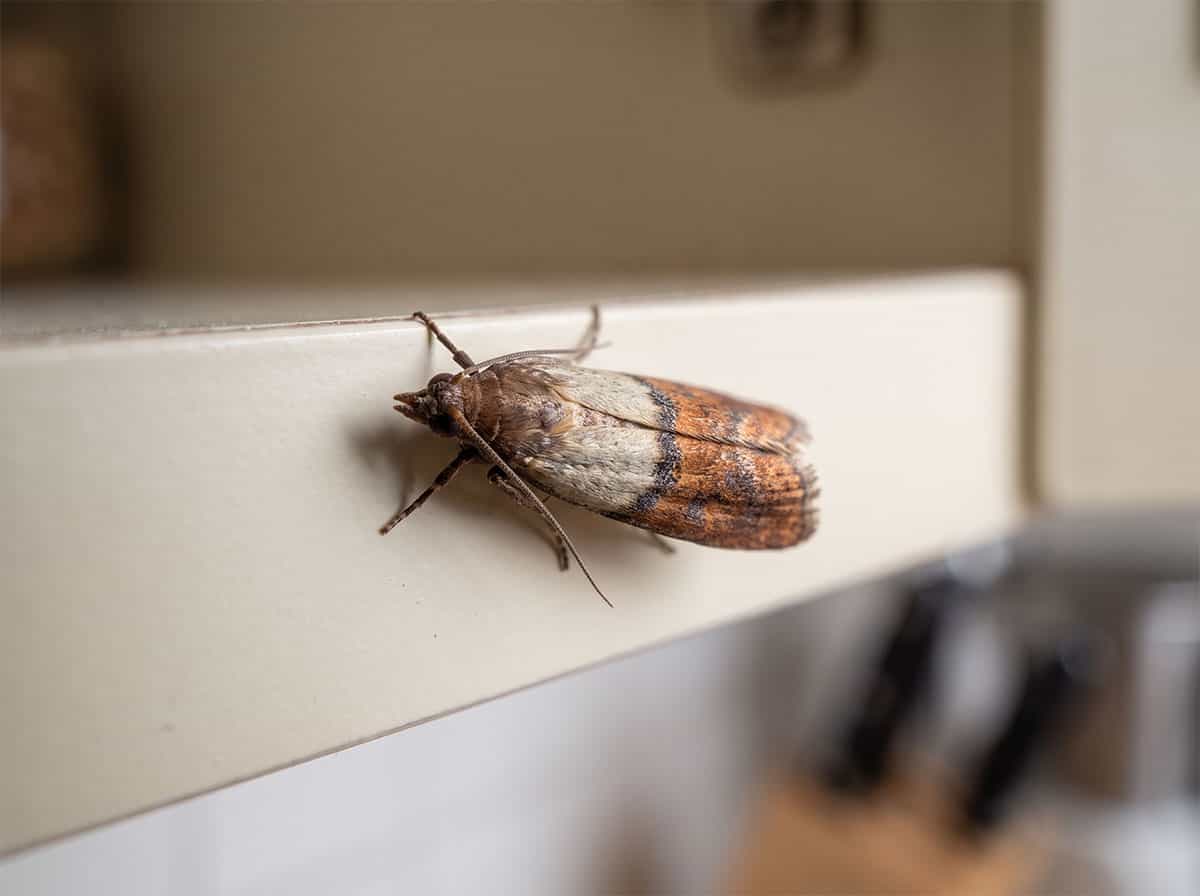
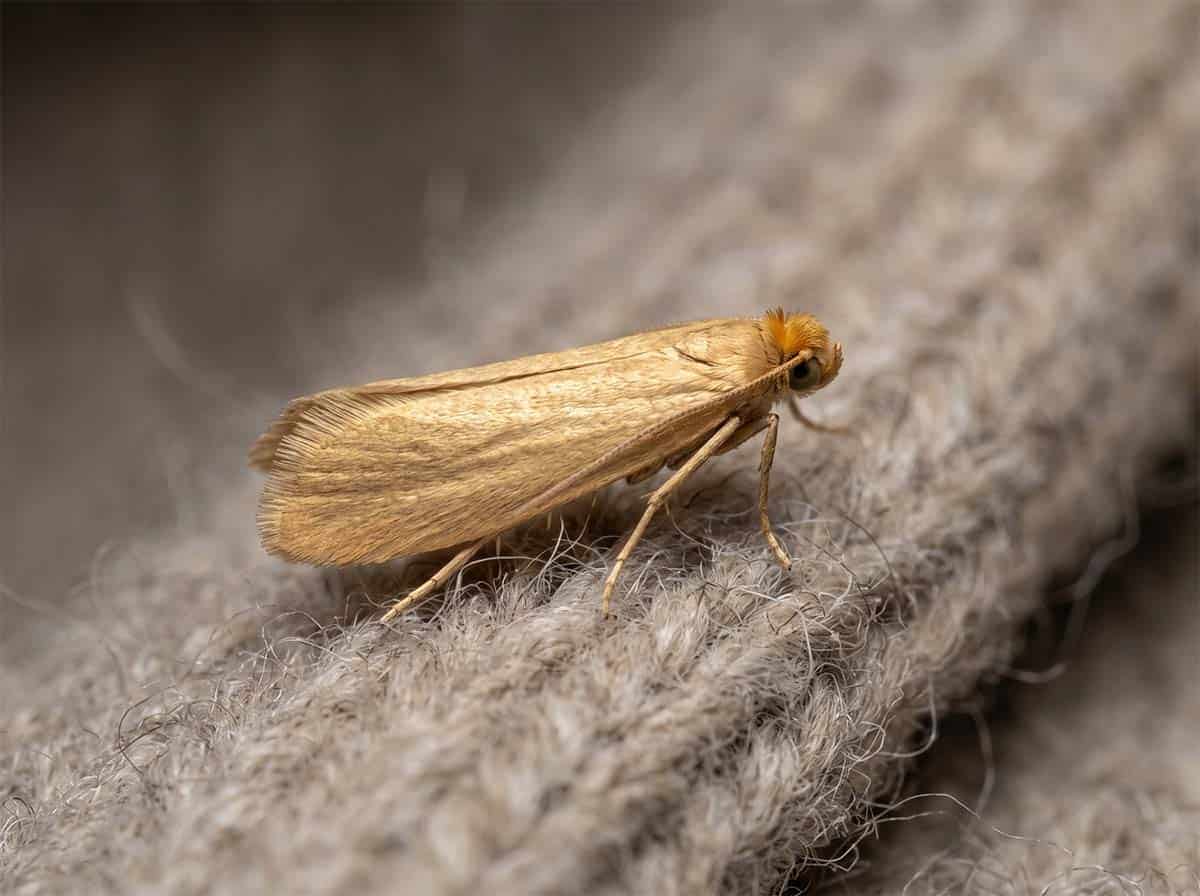
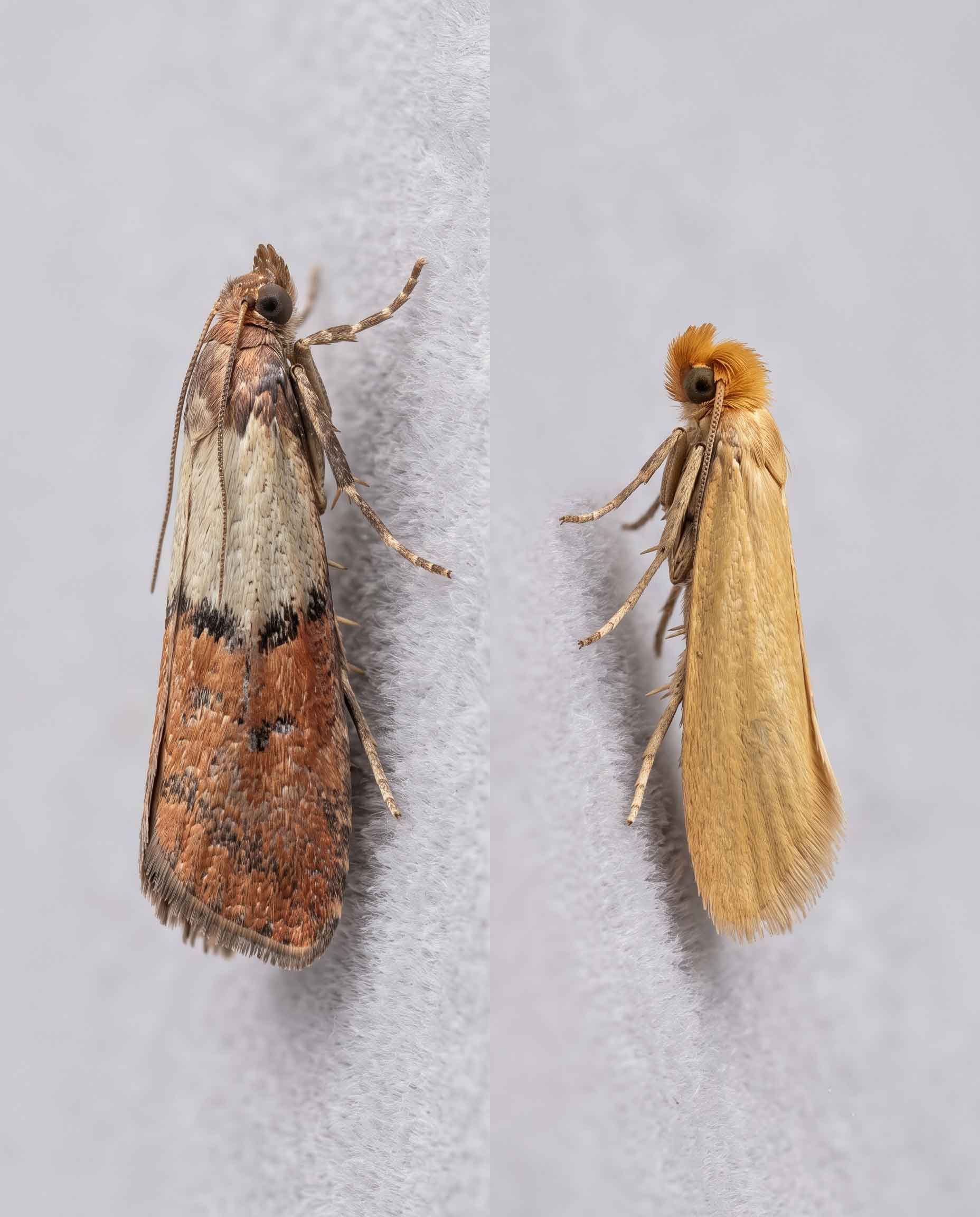
Look at where it is and whether it comes to the light. A pantry moth is 8 to 10 mm long with a distinctly two-tone forewing, pale grey at the base and coppery reddish-brown on the outer half, and it flutters weakly around the kitchen. A clothes moth is smaller at 5 to 8 mm, plain golden or buff with no markings at all, and it runs from light, scuttling into the dark of a wardrobe rather than flying to a lamp. With both, the adult moth you can see does not eat anything at all. The grubs do all the damage, hidden in the food packet or deep in the folds of a garment, which is why killing the moths on the wall never fixes it.
Two moths, two completely different problems
Getting this right matters, because everything you do next depends on which one you have.
| Feature | Pantry moth | Clothes moth |
|---|---|---|
| Size | 8 to 10 mm body, 13 to 20 mm wingspan | 5 to 8 mm body, roughly 10 to 15 mm wingspan |
| Markings | Two-tone. Pale grey or cream at the base, coppery reddish-brown on the outer half, often with a dark band between | None. Plain golden, buff or beige, slightly shiny, with a reddish-gold tuft on the head |
| Comes to light? | Yes. A weak, meandering flier, often seen around the kitchen at night | No. It avoids light and scuttles into dark folds when disturbed |
| Where you find it | Pantry and kitchen cupboards, and on walls and ceilings nearby | Wardrobes, drawers, storage boxes, carpet edges, under heavy furniture |
| What the grubs eat | Dry stored food: flour, rice, cereal, pasta, dried fruit, nuts, spices, chocolate, pet food, birdseed | Keratin only: wool, silk, cashmere, fur, feathers, felt, leather, wool carpet |
| Do adults feed? | No | No |
| The evidence | Silk webbing through the food, clumped or matted grains, tiny cocoons in cupboard corners | Irregular holes and grazed patches, silk tubes, and grit-like droppings the same colour as the fabric |
Sydney has two clothes moth species, the webbing clothes moth and the case-bearing clothes moth, both accidentally introduced. References: the Australian Museum and University of Kentucky Entomology.
The moth, the grub and the damage
The adult is the part you notice. The grub is the part that costs you money.
What to look for, in the pantry and the wardrobe
By the time you see moths flying, the grubs have usually been working for weeks. These are the signs that confirm it.
Webbing and clumping in dry food
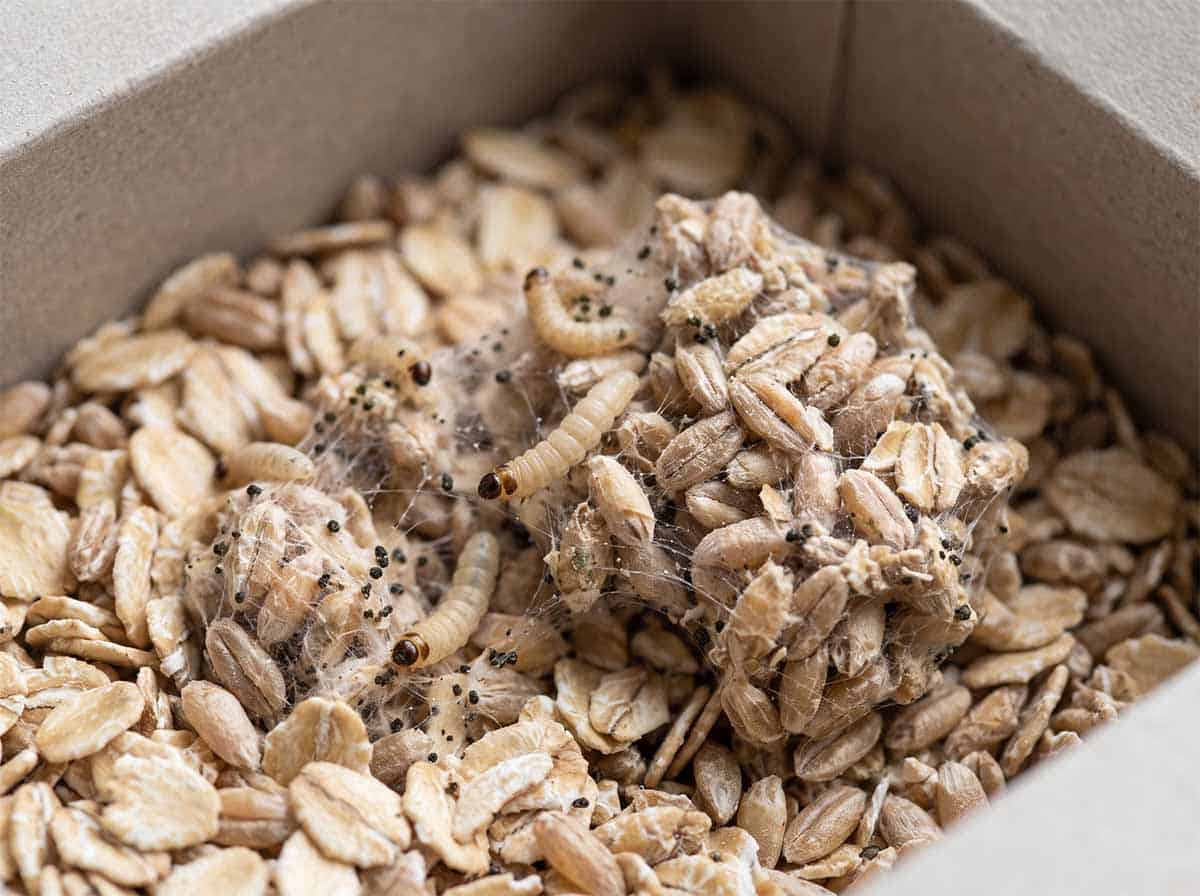
Grains, flour or cereal stuck together in matted lumps, with fine silk running through it. Usually the first real confirmation of pantry moths, along with grubs and shed skins in the packet.
Small cocoons in cupboard corners
When pantry moth grubs are ready to pupate they crawl away from the food, sometimes a long way, and spin cocoons in cupboard corners, under shelf lips and where the wall meets the ceiling. That is why you find them far from the pantry.
Irregular holes and threadbare patches
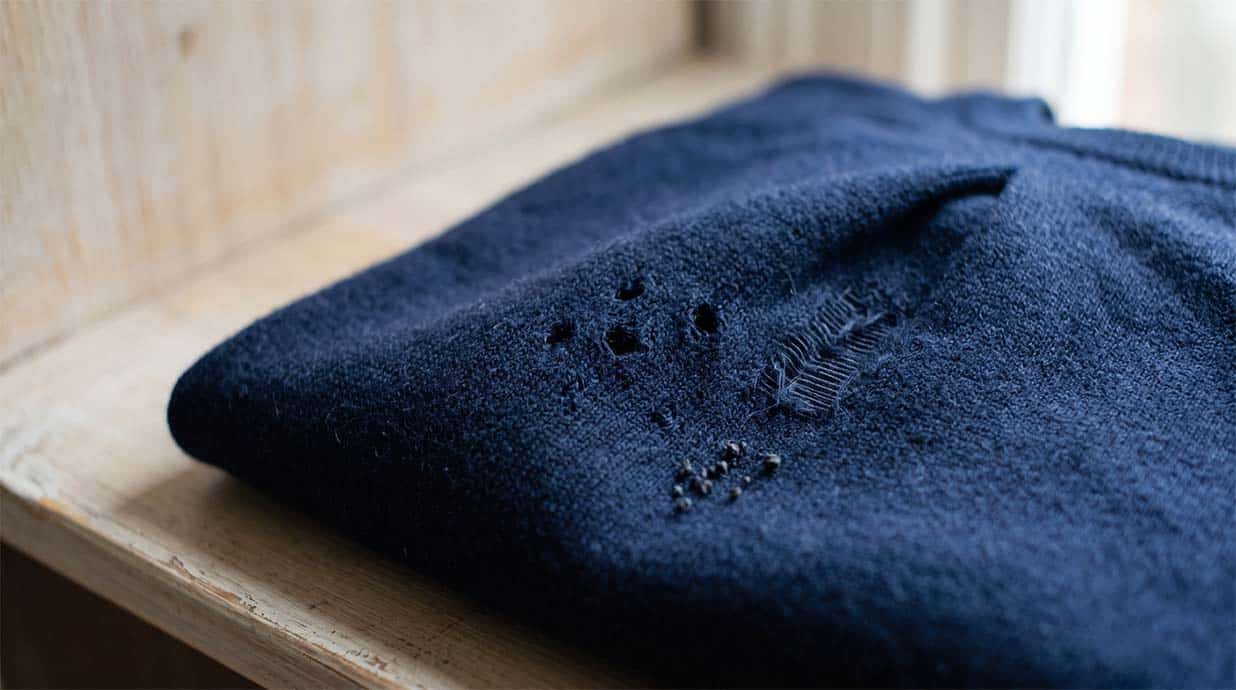
Clothes moth grubs graze the surface first, leaving thin, worn patches, then eat right through. Damage clusters in dark, undisturbed places: under collars, in cuffs and folds, in pockets and in stored boxes.
Grit the same colour as the jumper
The single best clothes moth tell. What looks like sand or dust under a woollen item is grub droppings, and it comes out the same colour as whatever they have been eating. Grit that matches the garment is not dust.
Silk tubes, or tiny portable cases
Webbing clothes moth grubs live in untidy silk tubes on the fabric. The case-bearing species carries a small silk case around with it, camouflaged with fibres from whatever it has eaten, so it matches the garment.
A small moth that runs instead of flying
Open the wardrobe and a little plain moth scuttles into a dark fold rather than flying out at you. That behaviour alone almost confirms a clothes moth, because they actively avoid light.
Most moths in your house are harmless
Australia has thousands of moth species and almost none of them are pests. Three quick checks sort it out.
The three-question check
| Question | Pantry moth | Clothes moth | Harmless outdoor moth |
|---|---|---|---|
| How big is it? | Small, 8 to 10 mm body | Very small, 5 to 8 mm body | Usually noticeably bigger |
| What is it doing? | Fluttering weakly around the kitchen | Running into dark folds, rarely flying | Circling a lamp or bumping the window |
| Where did it appear? | Near the pantry or food cupboards | In a wardrobe, drawer or storage box | Came in through an open window or door at night |
| Wing pattern | Two-tone, pale then coppery | Plain, no pattern at all | Anything: mottled, patterned, large |
A big moth bashing around the lamp at night is almost always an outdoor moth that flew in. Neither pest moth behaves like that: the clothes moth actively avoids light, and the pantry moth is a weak, meandering flier.
Holes in wool, or grazing on cotton and paper?
Clothes moth grubs eat keratin, the protein in animal fibres. That means wool, silk, cashmere, fur, feathers, felt, leather and wool carpet. They generally leave cotton, linen and synthetics alone unless those fabrics are blended with wool or soiled with sweat, food or body oils, which is exactly why an unwashed jumper packed away is the classic victim. If instead the damage is grazing and holes on cotton, linen, paper or cardboard, look at silverfish, which cannot digest keratin and so never touch wool. Carpet beetle grubs also eat keratin, but they are fuzzy and bristly rather than smooth caterpillars.
Not a health risk, but an expensive one
Neither moth bites or spreads disease. What they cost you is food, clothing and sometimes something irreplaceable.
Contaminated food
Pantry moths are not known to spread disease, and accidentally eating some is very unlikely to make you sick. The problem is contamination: silk webbing, shed skins and droppings right through the packet. Throw infested food out rather than sieving it.
Ruined woollens and carpet
This is the real cost. Clothes moths target the good stuff, wool, cashmere, silk and fur, and damage concentrates where you cannot see it. Wool carpet under heavy furniture and along skirting edges is a common and expensive one.
The damage is already old
By the time you find holes, the grubs that made them have usually pupated and gone. The larval stage can run for months, and adults live only a short time, so what you are looking at is a record of what happened weeks ago, not what is happening now.
Warm months for the pantry, all year for the wardrobe
Pantry moths run on temperature. In a warm Sydney kitchen the full cycle from egg to adult takes roughly six to eight weeks, and it can be quicker in a hot summer, so a single overlooked packet becomes a kitchen-wide problem fast. Numbers build through the warm months and slow down in winter, though a heated kitchen keeps them ticking over.
Clothes moths are more of a year-round problem, because a heated house lets them keep breeding through winter. That is also the worst time for it: winter is exactly when woollens, blankets and doonas are packed away or sitting undisturbed, which is precisely the dark, still condition the grubs want. Damage done in a storage box in June is not usually discovered until the weather turns.
Pantry and clothes moths, answered
How do I tell a pantry moth from a clothes moth?
Look at the wings, the size and the behaviour. A pantry moth is 8 to 10 mm long with a distinctly two-tone forewing, pale grey or cream at the base and coppery reddish-brown on the outer half, and it flies, usually fluttering weakly around the kitchen at night. A clothes moth is smaller, 5 to 8 mm, and completely plain golden or buff with no markings, and it avoids light, so it tends to run and scuttle into a dark fold rather than fly out at you. Where you found it is the other clue: pantry moths near food cupboards, clothes moths in wardrobes, drawers and storage boxes.
Where do pantry moths come from?
Most often they come home with your shopping. The eggs or grubs are usually already inside packaged dry food when you buy it, having got in at the processing or packaging stage, so an infestation is not a reflection on how clean your kitchen is. Common carriers are flour, rice, cereal, pasta, dried fruit, nuts, seeds, spices, chocolate, birdseed and dry pet food. The grubs can also chew through plastic bags and thin cardboard, so an unopened packet is not necessarily safe, and one overlooked packet can seed the whole cupboard.
Do clothes moths eat cotton and synthetics?
Generally no. Clothes moth grubs feed on keratin, the protein in animal fibres, so their targets are wool, silk, cashmere, fur, feathers, felt, leather and wool carpet. Cotton, linen and synthetics such as polyester and rayon are rarely attacked unless they are blended with wool, or soiled with food stains, sweat or body oils. That soiling is also what attracts the adults to lay eggs there in the first place, which is exactly why an unwashed jumper packed away over summer is the classic victim, and why cleaning things before you store them is the single best prevention.
Why does killing the moths not fix the problem?
Because the adult moths do not eat anything. Neither adult pantry moths nor adult clothes moths feed at all, so the moth on the wall has never touched your jumper or your flour. All the damage is done by the grubs, hidden inside a food packet or deep in the folds of a stored garment, and the larval stage can last for months. By the time you see adults flying, eggs have usually already been laid. So the job is always to find and remove the source, not to swat what you can see.
How do I get rid of pantry moths?
Find the infested food and bin it, checking everything including unopened packets, because grubs chew through bags and thin cardboard. Then empty the cupboard, vacuum the corners, shelf lips and cracks where the grubs crawl away to pupate, and wipe the shelves with warm soapy water. Store dry goods in airtight glass or hard plastic containers rather than bags, and freeze anything you want to keep for about a week to kill any eggs. Pheromone traps are useful for monitoring whether it has worked, but they only catch males, so they are not a control on their own. Insecticides are not recommended for pantry pests.
Do mothballs work, and are they safe?
Naphthalene mothballs are still sold in Australia, although the European Union banned them in 2008. They only work in a well-sealed container, because an ordinary wardrobe cannot hold a strong enough concentration to kill grubs, and the same limitation makes cedar and lavender insufficient on their own. On safety, NSW Health advises they should not be used in young children's rooms and that children's blankets and clothes should not be stored with them. Babies are particularly at risk, and people with the genetic blood condition G6PD deficiency can react to even small amounts. Keep them well away from children and pets, and air and wash clothing that has been stored with them. If you are worried about an exposure, ring the Poisons Information Centre on 13 11 26.
Moths in the pantry or the wardrobe?
We identify which moth you have, find where they are actually breeding, and treat it properly. Free quotes, no call-out charge, and a Sydney family business that has done this for 15 years.
Sources & references
Clothes moth species in Sydney: the Australian Museum. Clothes moth identification, the keratin diet, damage pattern, storage and cleaning: University of Kentucky Entomology and English Heritage. Pantry moth identification and lifecycle: University of Florida IFAS Extension and the Australian Environmental Pest Managers Association. Pantry control, and the advice that insecticides are not recommended for pantry pests: the UC Statewide IPM Program and the National Pesticide Information Center. Naphthalene safety and the advice on children: NSW Health. Measurements are typical ranges and vary between species. This guide is for identification and general information; for a suspected poisoning, ring the Poisons Information Centre on 13 11 26.