
Key takeaways
-
The new rules only apply to poisons and baits that contain a second-generation anticoagulant rodenticide (SGAR). Everything else is unchanged, so follow the label.
-
Rat and mouse bait is not banned. The rules around how you use it changed on 24 March 2026.
-
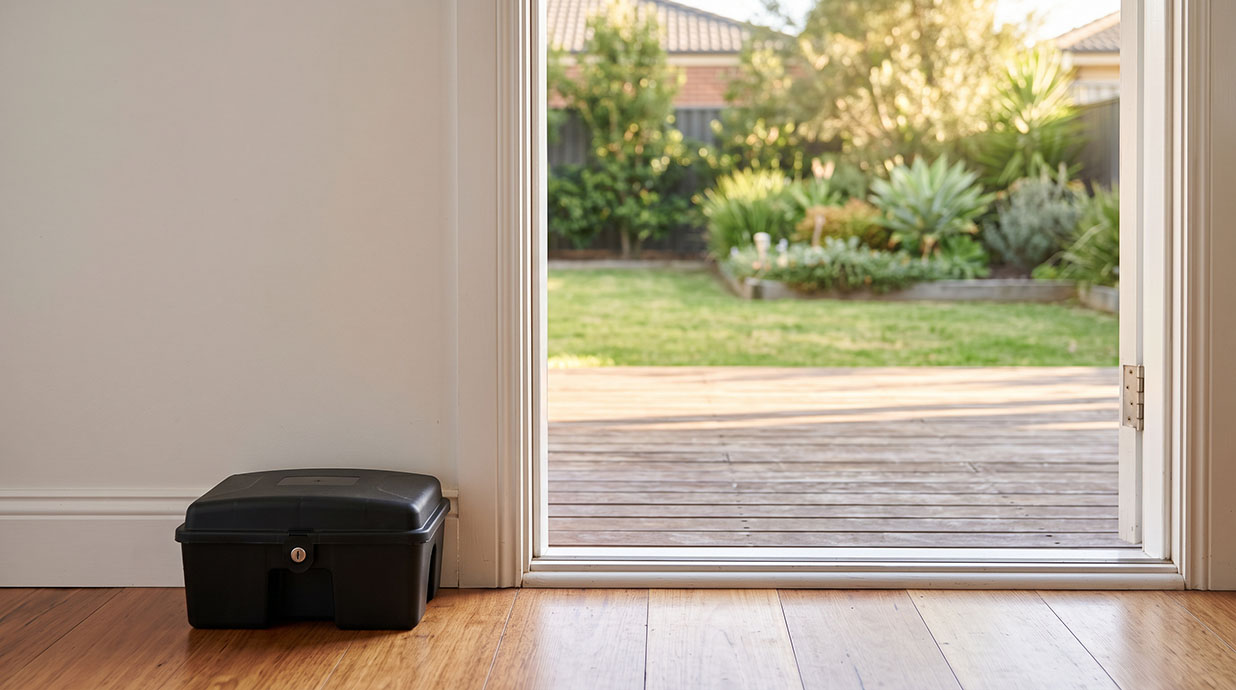
Bait boxes can still be installed outside, within 2 metres of the house. Shop-bought home baits are indoor-only products.
-
Bait must sit in a tamper-resistant bait station, fixed down where you can manage it.
-
Thirty-five days is the limit. If rodents are still active after that, the instructions tell you to get advice or call a professional.
-
The reason for all of it is secondary poisoning, which is what happens when an owl, a goanna, a dog or a cat eats a poisoned rat.
Here is the short version. On 24 March 2026 the Australian Pesticides and Veterinary Medicines Authority suspended the registration of every product containing a second-generation anticoagulant rodenticide for one year. These are the strong, fast-acting baits sold in supermarkets and hardware stores under brand names most people would recognise.
You can still buy them and you can still use them. What changed is how. The instructions that now apply replace whatever is printed on the packet, and for household products they are stricter than most people expect.
What actually changed, and what did not
It is worth being precise, because a lot of what has been written about this is a bit loose. This is not a new law and it is not a ban. It is a suspension, which is a temporary measure the regulator can use while it works through a longer review. It runs for one year from 24 March 2026.
During that year, these products can only be supplied and used in line with a specific set of instructions published by the APVMA. Those instructions sit on top of the label. Where the packet says one thing and the instructions say another, the instructions win.
That is also why you may have noticed a printed sheet handed to you at the checkout, or a leaflet stuck to the packet. Retailers are now required to physically give you a copy of the instructions when you buy one of these products. It is not marketing, it is the actual legal document, and it is worth reading.
Can I still buy rat bait?
Yes. Nothing about the suspension stops you walking into a hardware store or supermarket and buying rodent bait, and you do not need a licence or a qualification to do it.
Two things have changed at the shelf, though. Pack sizes are now limited, so the larger packs some products used to come in are no longer available. The cap is set product by product, commonly 150 g or 300 g depending on the line. And because new stock cannot be manufactured with the old labelling during the suspension, some product lines may become harder to find as existing stock works through.
The four rules that now apply at home
New rules only apply to poisons and baits that contain a second-generation anticoagulant rodenticide (SGAR). These are the instructions for products sold for domestic use. They are worth reading properly, because two of them are the opposite of what most people have always done.
-
Do not use it outdoors. At all.
This is the change that catches people out. Household rodent baits are now indoor-only. Bait in the garden, along the back fence, under the deck, in the shed or beside the compost bin is no longer permitted use, no matter how obvious the rat runway looks.
-
It has to be in a tamper-resistant bait station
Loose pellets in a roof cavity, bait blocks tucked behind the fridge and open trays on the floor are all out. The bait has to be secured inside a proper tamper-resistant station, and where you can, that station should be fixed to the ground or to a structure so it cannot be dragged somewhere else.
-
Thirty-five days, then stop and get help
You cannot leave bait down indefinitely. The instruction is not to use the product for longer than 35 days when treating an infestation, and if rodents are still active after that, to seek advice from the supplier or call a pest control service. In plain terms, if a month of baiting has not fixed it, the baiting is not the answer.
-
Go looking for the dead ones
You are expected to search for and dispose of dead rodents each time you check the bait, rather than leaving them where they fall. Wrap them in paper, put them in a plastic bag and put that in the rubbish. The same goes for uneaten bait when you are finished.
One extra thing about slugs and snails
The instructions also cover slugs and snails, which sounds odd until you know why. They are attracted to the bait, they are eaten by other animals, and they pass the poison along. If you find them around a station, the instruction is to move the station somewhere else in the affected area, away from them, and to dispose of the slugs and snails the same way as dead rodents.
Why the rules changed
The short answer is that these baits do not stop working when the rat dies.
A rat that has taken an anticoagulant bait does not die immediately. It keeps moving for several days, and during that time it is slower, more exposed and much easier to catch. Whatever eats it then takes on the poison too. That is called secondary poisoning, and it is the whole reason this review happened.
The animals on the receiving end are the ones most people would rather keep around. Boobook owls, barn owls and kookaburras hunt rodents directly. Goannas and quolls will happily scavenge a dead one. Blue-tongues get there by a different route again, eating the poisoned snails that collect around bait, which is why the instructions cover snails as well. Cats and dogs are exposed both ways, and that is the part that tends to land closest to home. The APVMA concluded that the way these products were being used was creating unacceptable risks to non-target animals, including native wildlife, pets and livestock.
Once you know that, the outdoor ban makes a lot more sense. Bait sitting in a garden is bait sitting where wildlife lives.
What to do to help prevent rodents coming from outside
- Cut off the food. Fallen fruit, chicken feed, pet food left out overnight, open compost and unsecured bins are the four that matter most in Sydney backyards. Rats stay where dinner is reliable.
- Close the way in. Rats fit through a gap the size of a twenty cent piece and mice through something closer to a pen lid. Weep holes, gaps under doors, torn vents, roof junctions and the point where pipes enter the wall are the usual entries.
- Clear the harbourage. Woodpiles against the fence, long grass, dense ground cover against the house and stacked junk down the side give them somewhere to live. Moving it away from the building does most of the work.
- Use traps outside instead of bait. Snap traps are still available and are not affected by these changes, since they are not a chemical product. Placed properly and checked daily, they deal with an outdoor problem without putting poison into the food chain.
- Treat indoors properly if they are already inside. Bait is still permitted indoors, in a station, with the 35 day limit. That is where it now belongs.
When it is worth calling someone
You do not need a professional for one mouse in the pantry in April. It is worth making the call when the situation looks like one of these.
You have been baiting for a month and the activity has not dropped, which the instructions themselves now treat as the point to get advice. The problem is outdoors and proofing has not shifted it. You can hear them in the roof or the wall cavity, where finding and removing carcasses is not something you can realistically do yourself. You have pets, chooks or small children and you would rather the poison was handled by someone licensed. Or you rent, or live in a strata building, in which case the rodent problem may not be yours to fix at all.
Rodents are also a winter pest, not a summer one. They come indoors when it cools off and food gets scarce outside, which is why activity picks up from about April and stays up through the coldest months. If you want the detail on which species you are actually dealing with and how to tell them apart, our guide to rats and mice in Sydney covers the identification side.
If you manage a building rather than live in one, the commercial rules are different again, stricter in some places but more permissive outdoors. We have set those out in a separate guide to what the rodent baiting changes mean for commercial property, which is the one to read if you are on a strata committee, run a food business or look after a portfolio.
For treatment across the Eastern Suburbs, see our rat and mouse control service.
Frequently asked questions
Rodent bait rules, answered
The questions we have been getting from Sydney households since the changes came in.
Get a free quoteCan I put rat bait outside anymore?
Household rodent baits are now indoor-only products. The instructions that apply to domestic products during the suspension say plainly not to use them outdoors, so bait in the garden, under the deck, in the shed or along the fence line is no longer permitted use. The reason is secondary poisoning. A poisoned rat stays alive and active for days, and anything that eats it outdoors takes on the poison too, which is how owls, goannas, quolls and family pets end up affected. However, due to the bait PestOz use in their rodent baits, we are allowed to still install bait stations outside as long as they are within 2 metres of the house.
Is rat bait dangerous to my dog or cat?
Yes, in two separate ways. A pet can eat the bait directly, which is exactly what tamper-resistant stations are meant to prevent, and a pet can be poisoned by eating a rodent that has already taken the bait. The second one is harder to guard against and is a large part of why the rules tightened. If you think your pet has eaten bait or a poisoned rodent, treat it as urgent and call your vet straight away, and take the packet or a photo of it with you so they know which active ingredient is involved.
There are rats in my yard. What can I actually do now?
Take away the three things keeping them there, and use traps rather than bait. Secure the bins, pick up fallen fruit, bring pet food and chicken feed in overnight and close the compost. Move woodpiles and clutter away from the house and cut back dense ground cover. Then seal the gaps, remembering a rat gets through a hole the size of a twenty cent piece. Snap traps are unaffected by these changes because they are not a chemical product, so they are the practical outdoor option now. If the activity does not drop, that is the point to get a professional in.
How long can I leave bait down inside?
Thirty-five days. The instruction for domestic products is not to use the product for longer than 35 days when treating an infestation, and if rodent activity is still there after that, to seek advice from the supplier or call a pest control service. It is a sensible cut-off even setting the rules aside. If a month of baiting has not fixed the problem, something is feeding them or letting them in, and more bait will not change that.
What do I do with a dead rat?
Look for them rather than waiting to smell them, and get them out of the area. The instructions ask you to search for and dispose of dead rodents each time you check the bait, precisely so nothing else eats them. Wrap the carcass in paper, put it in a plastic bag and put that in the rubbish bin, and do the same with any uneaten bait once you are done. Wear gloves. If they are dying somewhere you cannot reach, like a wall or roof cavity, that is a good reason to hand the job over.
Do these rules apply to rat traps too?
No. The suspension and its instructions apply to chemical products, so snap traps, live traps and other non-chemical controls are not covered and remain available. That is part of why traps are now the sensible choice outdoors. Do check them daily and dispatch anything caught humanely, since animal welfare obligations still apply and vary by state, and be aware that native animals can and do end up in traps set for rats.
Why was I handed a printed sheet when I bought bait?
Because the retailer has to give it to you. From 24 March 2026, these products cannot be supplied unless the buyer is also given a physical copy of the instructions for use. Some shops print the pages, others attach a sticker or leaflet to the packet. It is the document that overrides the directions printed on the pack, so it is worth keeping rather than binning at the car. If nobody gave you one, ask, because the packet on its own is no longer the full picture.
I rent, or I am in a strata building. Whose job is this?
Usually not yours alone. In a rental, rodents getting in through gaps, damaged vents or roof access are generally a maintenance issue for the landlord or agent, so report it in writing rather than buying bait and absorbing the problem. In a strata building, anything in common property such as bin rooms, basements, gardens and shared roof spaces is the owners corporation’s responsibility, and baiting your own lot rarely fixes a building-wide problem. Report it to the strata manager, since the building may already be on a rodent program that needs adjusting.
Rodents in the roof, walls or yard?
PestOz has been dealing with Sydney rats and mice for more than 15 years. We will find how they are getting in, treat it within the current rules and tell you what needs sealing so it does not come back.
Where this information comes from
- APVMA Gazette No 5, Tuesday 10 March 2026, Attachment 2, Instructions for possession, custody, and use of suspended chemical products. View the Gazette
- APVMA, APVMA certifies that second generation anticoagulant rodenticides should be restricted chemical products. Read the announcement
- APVMA, FAQs on anticoagulant rodenticides and actions by the APVMA. Read the FAQs
Last checked 26 August 2026. The suspension runs for one year from 24 March 2026 and a wider review of all rodent baits, including the older first-generation products, is still underway. We update this page as decisions are published. This is general information, not legal advice.