
Why do ants keep returning to the same spot?
The short answer
Ants keep coming back because a nearby colony has marked your home as a reliable feeding ground, and the invisible scent trail leading its workers in does not wash off when you wipe the surface.
Here is the thing most people get wrong about ants: the ones on your bench are not the problem. They are a symptom. If you are wondering why ants are in your kitchen week after week, look past the ones you can see. Squash the foragers on the bench and the colony replaces them before you have rinsed the cloth.
Colonies run scouts around the clock. The moment one finds something worth eating, it lays a chemical trail that recruits dozens, then hundreds, of workers. That trail is the real culprit. Until the colony is dealt with and the attractant is gone, your kitchen stays on the map.
In the eastern suburbs we see this constantly. Think of the older Bondi and Bronte terraces and the deco blocks around Bondi Junction, where homes share walls and garden beds press right up against the slab. Several colonies often border a single property. Treat one and another fills the gap. That is why recurring ant activity is so common around here, and why a one-off can of spray rarely holds for long.
How do ants find food and communicate its location to the colony?
The short answer
Scouts do the finding. Pheromone trails do the telling.
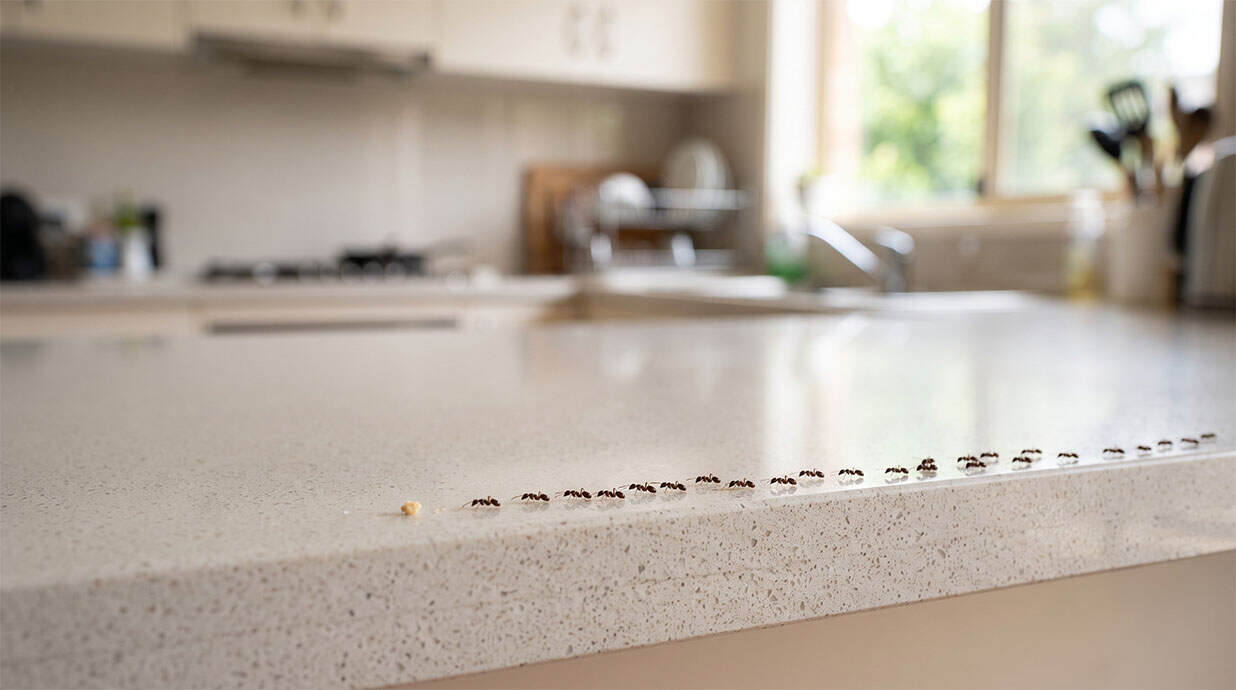
A scout wanders more or less at random until it hits something edible. On the way home it dabs a chemical scent along its path, and the workers that follow reinforce that scent every time they make the return trip. In over 20 years of tracing columns across kitchen benches in the eastern suburbs, we have watched this play out countless times, and you can see it on your own benchtop if you look closely.
How one scout becomes a column
- The scout. A lone ant wanders until it finds food or water.
- The scent trail. On the way home it lays a chemical trail back to the nest.
- The column. Workers follow the trail and top up the scent every trip, so the busier it gets, the harder it pulls.
- The wipe. Clean a stretch and scouts re-lay it, often a few centimetres over. The nest is untouched.
The result is a fast feedback loop. One crumb found by one scout can become a column of hundreds inside an hour, because the busier the trail, the stronger the scent, and the stronger the scent, the more ants it pulls in. It is a brutally simple system. It works.
What that means for your home is straightforward. The ants marching across the bench are not lost. They are following directions. That is why they turn up so suddenly, in such numbers, and all heading to and from the same point.
- A lone ant exploring your kitchen is usually a scout.
- Where one scout succeeds, a trail and a column follow quickly.
- The trail can linger on the surface for a while after the food is gone.
- Squashing the column removes workers but leaves the scent instructions in place.
Why do ants walk in trails, and what happens when those trails are disturbed?
The short answer
Ants walk in trails because following a path somebody already mapped beats every ant searching alone.
The trail is a shared memory written in chemicals. It records where the food is, how good it is and the shortest way there. Trails tend to hug edges: skirting boards, grout lines, cables and window frames, because ants like to travel with a surface against them. We often trace a column straight back along the mortar line of a brick wall to a weep hole.
Wipe a trail with water or ordinary spray cleaner and you break the scent in that one spot. The ants scatter and mill about for a bit. They do not quit. Within minutes to hours the scouts have re-laid the path, often on a slightly different route to the same destination. That is why they seem to reappear after cleaning, and why they sometimes pop up at a fresh entry point a few centimetres over.
Wiping buys time. It does not fix it.
Disturbing a trail without removing the food or treating the colony just resets the clock. Wiping with warm soapy water or a vinegar solution is worth doing to buy time and make the kitchen less inviting. Treat it as a holding measure, not a cure.
Why are ants appearing in my kitchen even when it is clean?
The short answer
Because what counts as clean to you is a banquet to an ant.
This is the honest answer to why ants turn up in a kitchen when the benches look spotless. Ants are tiny and they need almost nothing. A film of grease behind the toaster. A sugar smear in a pantry corner. A sticky honey jar lid, crumbs under the fridge, the cat’s bowl, the sweet residue around the bin. Any one of those will do.
Water matters as much as food. Ants need moisture, and a kitchen hands it to them: the damp around a dripping tap, condensation under the sink, a wet sponge, pet bowls, drain openings. Through the warmer months we are called out to plenty of homes where there is no food problem at all and the ants have simply come in for a drink.
Then there is access. Ants get in through gaps you would never spot: around pipes, under door seals, through weep holes, through hairline cracks in grout or render. A kitchen can be immaculate on top and still sit above an easy run in from a colony in the wall cavity, the garden bed or under the slab.
Food
- Grease films and cooking residue on and behind appliances
- Pantry spills, sugary residue and poorly sealed food containers
- Pet food left out overnight
Water
- Moisture from leaks, condensation, sponges and drains
- Pet water bowls left out overnight
A way in
- Entry gaps around pipes, seals, weep holes and grout
If you are also noticing other pests following the same moisture and food, our guidance on preventing rats and mice in your Sydney home covers many of the same sealing and hygiene principles.
Why do ants sometimes prefer sugary foods and other times seek protein or grease?
The short answer
Because the colony’s needs change through the season.
For much of the year the workers forage for carbohydrates, sugars and sweet liquids that fuel their daily grind. That is when you find them mobbing spilled juice, honey or cut fruit.
At other times, especially while the colony is raising brood, the demand flips to protein and fat. Suddenly the sugar they were obsessed with last week gets ignored and they go for grease, meat scraps, pet food, oil residue, anything rich. Nothing has gone wrong in your kitchen. The colony’s shopping list has changed. Researchers at the University of Sydney found the same split in the lab: the workers run on carbohydrates, the larvae need protein, and what foragers bring home depends on whether there are larvae to feed.
-
Sugar mode
Workers fuelling up
Carbohydrates are the colony’s everyday energy, so sweet spills draw the biggest trails.
- Spilled juice
- Honey
- Cut fruit
- Pantry sugar
- Soft drink rings
-
Protein mode
A colony raising brood
Larvae need protein and fat to grow, so foragers walk past the sugar and go for anything rich.
- Pet food
- Meat scraps
- Grease and oil
- Cooking residue
This is where DIY baiting comes unstuck. Most supermarket baits are either sugar-based or protein-based, and a colony that is currently after protein will walk straight past a sugar bait and make it look useless. Matching the bait to what the colony actually wants right now is one of the things that separates a treatment that works from one that just annoys you. It is also why a bait station half-works, then fails, and people assume ants are unbeatable.
The species matters too. Black house ants, Argentine ants and coastal brown ants all behave a little differently, and our guide to identifying Sydney ants shows how to tell them apart.
How do rain, heat and dry weather affect ant activity in Sydney homes?
The short answer
Weather is one of the biggest triggers for ants coming indoors in Sydney.
Heavy rain floods nests and tunnels, so colonies shift to higher, drier ground, and the inside of your home fits the description perfectly. A soggy week is often followed by a surge of ants along skirting boards and through kitchens and bathrooms.
Heat and dry spells push them in for the opposite reason. When the ground bakes and outdoor moisture vanishes, ants come hunting for water, which is why you see a jump around sinks, drains, pet bowls and bathrooms during a hot, dry stretch of a Sydney summer. Warmth also revs up their metabolism and breeding, so colonies grow larger and forage harder.
Because Sydney swings between humid downpours and dry heat, many homes cop two distinct waves of ant pressure across the warmer half of the year. Read the weather and respond accordingly:
- After heavy rain, seal entry points and check higher ground: benchtops, window sills and upper cupboards.
- During dry heat, deny them water by fixing leaks, drying the sink at night and lifting pet bowls.
- If workers keep marching in regardless, the lasting answer is treatment at the source.
For the whole year at a glance, our Sydney pest calendar shows when ants and everything else peak, and our spring pest guide covers the season we are in now.
When should you call a professional about recurring ants?
The short answer
Call a professional when ants keep returning despite cleaning and baiting, when you can see multiple trails or entry points, or when you cannot find the nest.
Recurring activity usually means one or more established colonies on or near the property, and those need treating at the source with the right product matched to the species and the season. That is exactly what our ant control service does.
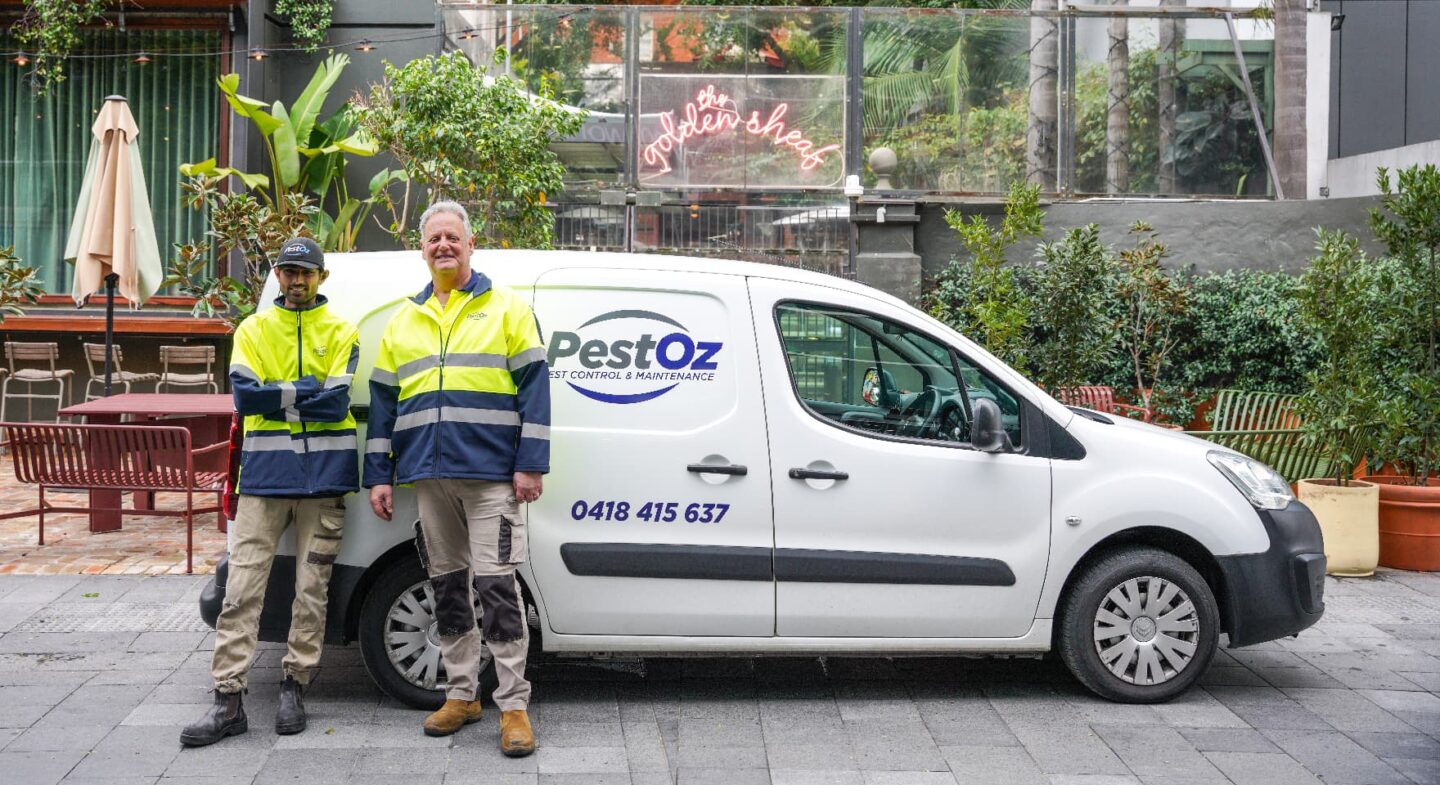
PestOz is a family owned and operated business based in Bondi, serving Sydney’s eastern suburbs and greater Sydney with over 20 years behind us. Our residential pest control starts the same way every time: we identify the species, trace the trails back to the colony, treat the source rather than the symptom, and use treatments that are safe around children and pets. You get a specific appointment time, not a four hour window, and no hidden costs. It is the same approach the strata and property managers we work for rely on.
Ant control
Ants that keep coming back? We will sort it properly.
If the ants in your kitchen keep coming back no matter what you try, get in touch with PestOz. Tell us where you see them and when, and we will give you a straight answer and a real appointment time.
-
Family run, Bondi based
Over 20 years tracing trails back to the colony across the eastern suburbs.
-
Child and pet friendly
No hidden costs. Licensed, insured and CM3 certified.
-
A specific appointment time
Not a four hour window, so you are not writing off half a day.
Frequently asked questions
Ants that keep coming back, answered
Book an ant treatment
Why do ants come back after I spray them?
Surface sprays kill the foragers you can see but not the colony that sent them or the queen churning out more. The scent trail also survives the spray, so fresh workers just follow it straight back in. Lasting control needs the colony treated at its source.
Does wiping away ant trails get rid of ants?
Wiping with warm soapy water or vinegar breaks the scent trail for a while and is worth doing, but it is only a holding measure. Scouts re-lay the trail within hours if the food source and the colony are still there. It reduces the problem without solving it.
Why do ants ignore the bait I put down?
Ants switch between craving sugar and craving protein or grease depending on what the colony needs at the time. If your bait is sugar-based while the colony is after protein, the ants will walk straight past it. Matching the bait to the current preference is essential, and getting it wrong is a common reason DIY baiting fails.
Are there more ants in Sydney after rain?
Yes. Heavy rain floods underground nests, so colonies move to higher, drier ground, which often means inside your home. A wet spell is frequently followed by a noticeable surge of ants along skirting boards and through kitchens and bathrooms.
Sources
- Czaczkes, Grüter and Ratnieks (2015), Trail pheromones: an integrative view of their role in social insect colony organization, Annual Review of Entomology.
- Dussutour and Simpson, University of Sydney (2009), Communal nutrition in ants, Current Biology.